
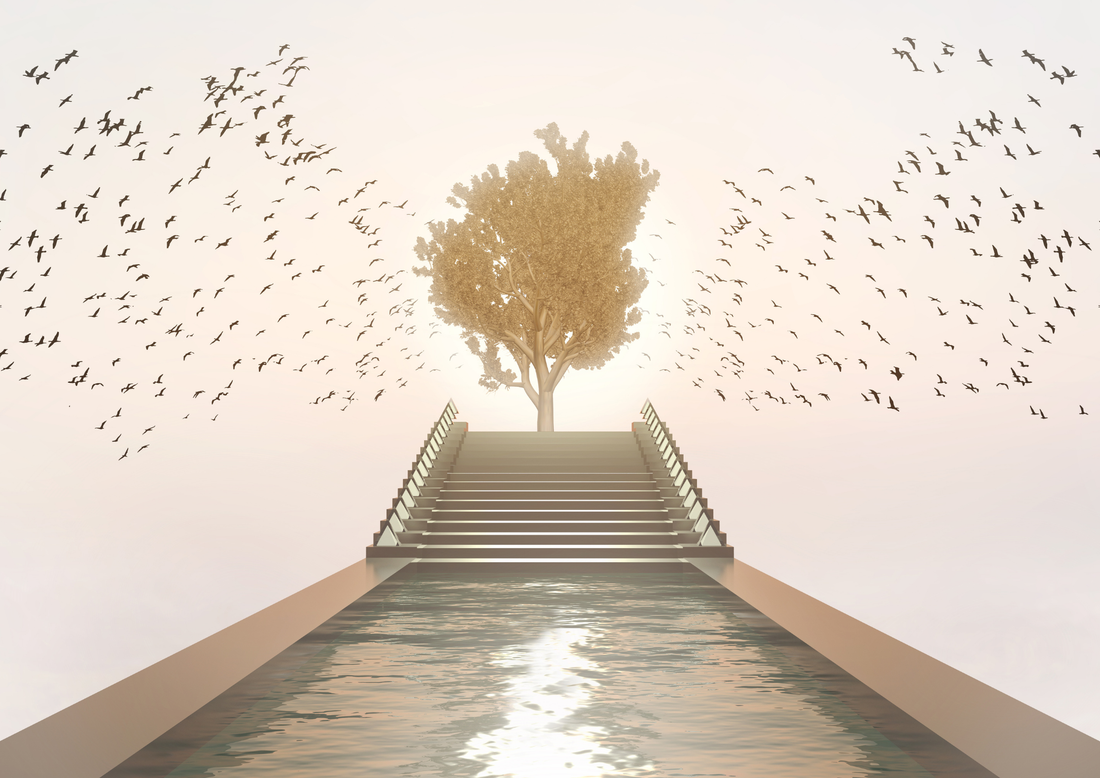
What does it mean to reclaim our own consciousness in an age where so much of our attention has been outsourced?
At a time when our attention is increasingly fragmented and our identities are shaped by external systems, the greatest act of freedom may be to turn inward. Embarking on this journey allows us to know thyself enough to participate in the world consciously.
With the advancement of technology, many of us feel increasingly disconnected from ourselves, from one another, and from the living world. We have access to more information than any generation before us, yet wisdom often feels elusive. Our culture encourages us to seek outward toward achievement, consumption, certainty, and endless stimulation. There is an abundance of content that serves only as a distraction from our own self-realization, but there are also resources such as The Unfolding Self by Ralph Metzner and Psyche Unbound that can guide us toward deeper self-understanding, the cultivation of wisdom, and the expansion of consciousness.
The act of turning inward may be one of the most radical acts, especially now. Through exploring our inner selves, our psyche, and the nature of consciousness, we cultivate greater self-agency, allowing us to participate more consciously in the unfolding of our lives and our place within the greater whole.
Throughout history, philosophers, mystics, psychologists, and Indigenous wisdom keepers such as Stanislav Grof, Ralph Metzner, and María Sabina have all pointed toward the same frontier:
Consciousness itself.
The Forgotten Territory
Amidst constant distraction and endless stimulation, we overlook the important questions that naturally arise when we allow ourselves to become still and quiet, or when we’re lying in bed just before we drift to sleep and begin contemplating our own existence.
- Who am I?
- Who is aware?
- Can consciousness evolve?
These questions are often dismissed as philosophical, abstract, or beyond the reach of everyday life. Yet they are among the most practical questions we can ask, especially now if we are to live consciously, in right relationship with nature, with one another, and with ourselves.
As we search for solutions to the many ecological, political, and technological challenges facing our world, we rarely pause to ask a more fundamental question:
What consciousness are we operating from that is creating the world we live in?
Perhaps the many crises of our time are not separate crises at all, but expressions of a deeper one—a crisis of consciousness. In forgetting the nature of ourselves, we have also forgotten our relationship to one another, to the living Earth, and to the deeper intelligence that connects us all.
Remembering the Sacred
In recent years, the exploration of consciousness has entered mainstream conversation, and many have become curious about altered states. Yet as this interest has grown, there is also the risk of forgetting something essential: the exploration of consciousness is not merely something to study, optimize, or consume.
María Sabina reminds us of another way of relating to consciousness. As a Mazatec curandera, her healing ceremonies were acts of prayer, communion, and service. The sacred mushrooms she worked with were never understood as substances or tools for personal enhancement, but as part of a living relationship with the sacred.
The journey inward becomes less about acquiring extraordinary experiences and more about cultivating humility, presence, and right relationship with ourselves and the world. Through the expansion of consciousness, a deeper understanding of the interconnectedness and unity of all aspects of life becomes known and informs the way we move in the world.
The Unfolding Self
This journey of self-discovery and self-realization is one of uncovering what has been there all along, always present beneath our thoughts, sensations, conditioning, and the constant content of the mind.
Throughout his life, Ralph Metzner explored the evolution of consciousness through psychology, ecology, meditation, mythology, and contemplative practice. Rather than viewing the self as something fixed, he understood human development as an ongoing unfolding that continues throughout our lives as our awareness deepens and our relationship with ourselves, others, and the living world matures.
This perspective offers a powerful alternative to a culture that encourages us to define ourselves through external achievement or identity. The unfolding self is not measured by what we accumulate, but by the depth of our awareness, our capacity for compassion, and our willingness to remain open to transformation.
To know ourselves is to cultivate a lifelong relationship with inquiry, allowing each stage of life to reveal another layer of who we are. As consciousness unfolds, so too does our ability to live with greater presence, discernment, and responsibility.
Psyche Unbound: Expanding the Conversation
If the exploration of consciousness is one of humanity's oldest pursuits, it is also one of its newest frontiers. Throughout history, philosophers, mystics, scientists, and Indigenous wisdom keepers have sought to understand the mysteries of the psyche from different perspectives.
Psyche Unbound brings many of these conversations into dialogue, offering a potent collection of essays that explore consciousness through psychiatry, mythology, anthropology, spirituality, neuroscience, and transpersonal psychology.
Rather than reducing the human experience to diagnosis or pathology alone, the contributors invite us to ask deeper questions:
- What capacities lie dormant within us?
- How do non-ordinary states of consciousness contribute to healing, creativity, and transformation?
- What might we discover if we approached consciousness not as something to explain away, but as one of the greatest mysteries of human existence?
At its heart, Psyche Unbound reminds us that consciousness cannot be fully understood from a single discipline or worldview. It calls for a conversation that bridges science and spirituality, psychology and ecology, ancient wisdom and contemporary research. In doing so, it reflects a growing recognition that understanding the psyche is not only a scientific endeavour, but a deeply human one.
As our understanding of consciousness continues to evolve, so too does our understanding of ourselves. We may never arrive at definitive answers, but along the journey we come to realize how much we do not know. In that realization, we cultivate the curiosity, humility, and discernment to continue asking meaningful questions. In this way, the exploration of consciousness becomes less a destination and reveals itself as an ever-unfolding inquiry, which has the potential to transform not only how we see ourselves, but how we relate to one another and to the living world.
The Revolution of Going Within
Right now as algorithms shape our attention, artificial intelligence transforms the way we think and create, and information fills our minds we must ask ourselves, ‘Who are we becoming while using it?’
No innovation can substitute for self-understanding, and no external advancement can replace the lifelong work of self-discovery and knowing what lies within our psyche.
The inward journey can be seen as an act of withdrawal from the world but in contrary, by going within, we can actually participate more consciously in it. As we become aware of our fears, our conditioning, and the patterns that shape our lives, we cultivate greater self-agency, compassion, and responsibility. A person who understands themselves is less easily manipulated, less likely to project their suffering onto others, and more capable of contributing consciously to the world around them.
Perhaps the greatest transformation we can offer the world begins within.
As consciousness expands, so too does our capacity to shape a culture rooted in wisdom, reciprocity, and care. In remembering ourselves, we begin to remember our responsibility to one another, to the living Earth, and to the future we are creating together.


